Collecting · October 21, 2026
Every Piece Does Something to Me: Christoph Hertz on Art as a Counterweight
Auf Deutsch lesenWhat drives people to collect art? And which paths lead them there?
In our series “Collectors in Conversation”, art collectors offer insights into the personal stories behind their collections. What sparked their interest in art? Which works have accompanied them over the years? And how do artists, social developments, and individual life paths shape the way they look at art and collecting?
In this edition, we speak with Christoph Hertz. Twenty-three years ago, he and a school friend began selling projectors on eBay. That venture became visunext, a provider of media technology and room solutions that ships across Europe. Today, his private collection hangs in the company’s hallways and offices – by now more than 200 works of international contemporary art, from painting, photography, and sculpture to conceptual positions, complemented by art-historical works from the circle of the ZERO movement. Walter Gehlen visited him there.
We are sitting in your offices, surrounded by your collection. Is this a personal luxury or a gesture to your team?
First and foremost, it’s private. The art has nothing to do with the company – we are two partners, and I’m glad my partner lets me fill the office with it. I want to live with art, and that includes the place where I spend my day. Every work does something to me. Still, I notice that many on the team appreciate it. Art still has a real barrier to entry, and here you find a way in. And we furnish rooms: people shape the room, then the room shapes the people. Art plays a significant part in that.
How did it begin?
In my childhood bedroom. That was around the time eBay arrived, and I bought canvases by eBay artists as decoration. My siblings are eleven and fourteen years older; at home, everything was a generation out of step. I think I wanted to create something that didn’t exist in our house. I was always interested in design – I did my school internship at Bang & Olufsen. With the first money of my own, I stumbled across real art: in 2005, at 21, I bought an embossed print by Günther Uecker. That was the beginning.
Is there a connection between your work as an entrepreneur and the art?
Yes and no. My market, above all electronics, is extremely transparent. Every product has an EAN code; on price comparison sites, everything is comparable. And the products are ephemeral: in five years, much of what we sell is obsolete. So what I do is transparent and ephemeral. The art market is the opposite: opaque and enduring. That really appealed to me in my early twenties, and it remains a welcome balance to this day.
It is precisely this opacity that puts many people off. Two paintings, similar in size, and one price can be many times the other. What role does price play for you?
I understand that it deters people. A factor of 10 or 50 between two similar works is hard to grasp at first. But deciphering that is exactly what I find exciting. It’s like music: a street musician can mean as much to someone as a commercially successful artist. What you spend depends on your own attitude. Whether you commit one per cent of your means or fifty makes a difference. I consider making money from art fairly theoretical. Statistically, it’s unlikely that a work will later sell above its gallery price. Of course it’s affirming when you’ve spotted something early that the market recognises later. But that’s only one facet.
What happens the moment you stand in front of a work?
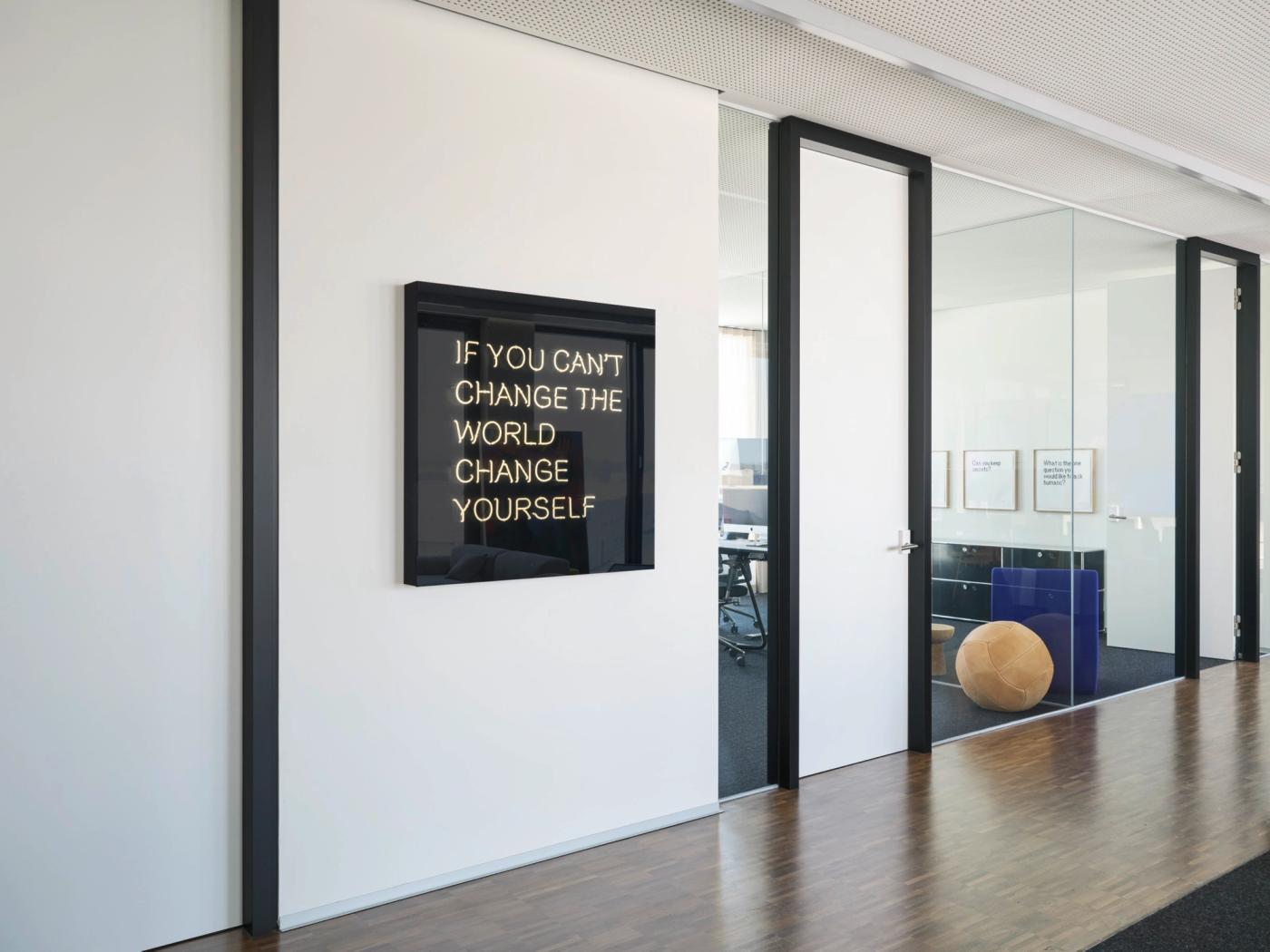
At a fair I see a thousand works, and I don’t stop at each one to ask what the artist was thinking. First, something has to appeal to me visually. Often I follow someone for years and notice: there is a thread running through their work. Or it’s something radically new that surprises me. Some works reveal themselves immediately – the mirror by Jeppe Hein, for instance: if you can’t change the world, change yourself. It always hung outside my office. That’s provocative and simple: it’s yours, you decide. Other works have layers you have to uncover first.
Have you ever been reckless?
Often, absolutely. Passion comes from suffering, after all. But I don’t regret anything. I made every decision with the knowledge and the means I had at the time. With some artists, I could have bought more consistently earlier on. But I’m a long way from reproaching myself.
When did the art buyer become a collector?
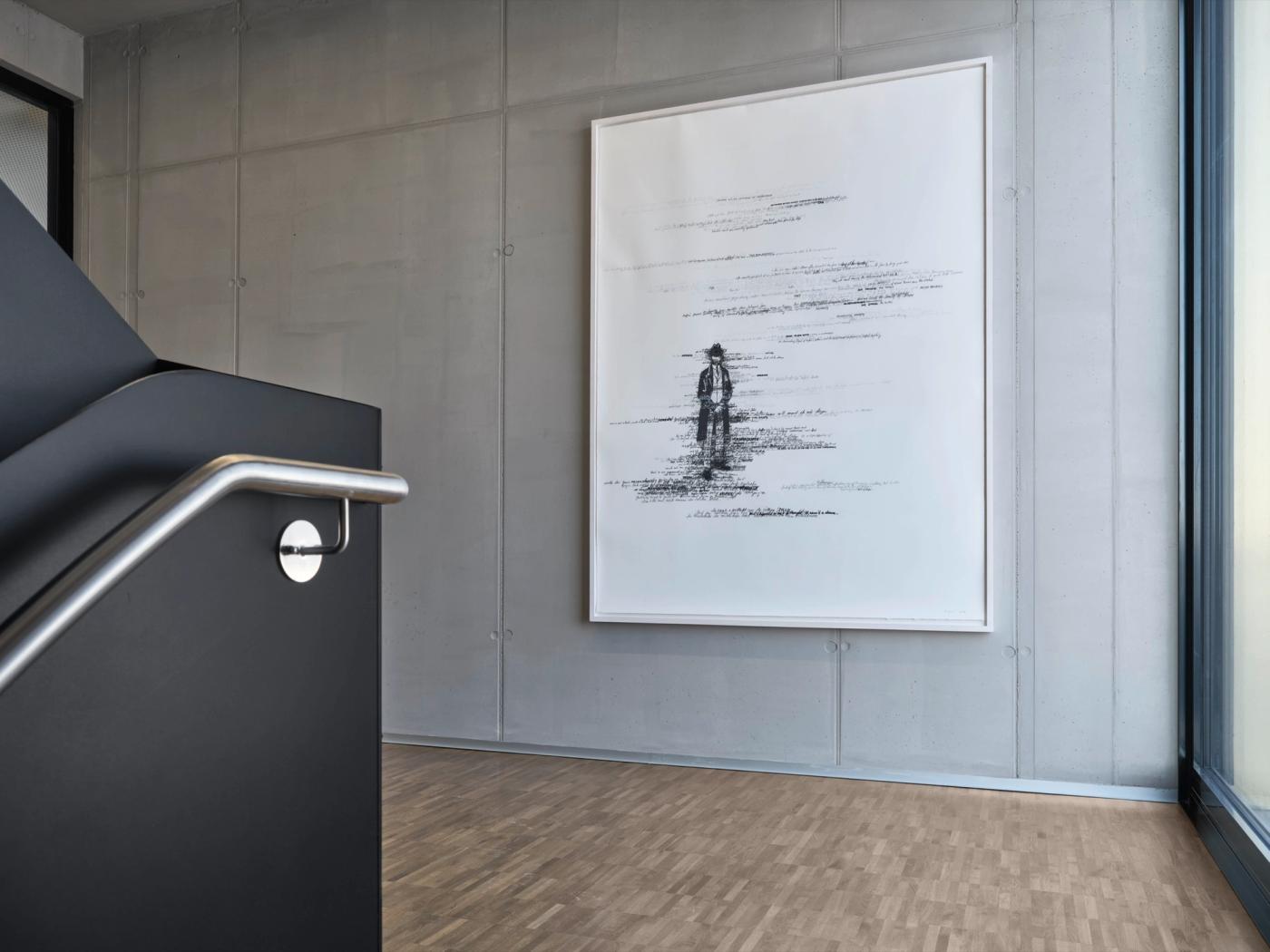
The first moment is when you run out of walls and start putting works into storage. The second came when it became clear to me: art wants to be seen. That matters to artists. Is it right to hoard on this scale just for myself? Or is it more responsible to share, because at its best, art gives something to more than just me? Last year I completed a website for the collection. Before that, everything was in Excel. It began as an archive project, but for the first time I saw the works assembled and asked myself: are there connections? How did this happen? I also lend works out regularly. Brigitte Waldach’s cycle “History Now” usually hangs in our stairwell; right now it’s on view at Museum Schloss Moyland. That obligation towards the artists matters to me.
Where do you buy?
Mostly at fairs: Basel, Cologne, probably Paris soon. And next year, Düsseldorf is a must. I like the setting at Areal Böhler, the contrasts, the building itself. It’s a more beautiful backdrop than a rectangular exhibition-hall box. Through fairs you make contacts with galleries who keep you up to date. In fact, I’ve bought more through PDFs than directly at the stand. If you know how an artist works, you can picture the piece. And I follow the auction market to buy works I missed.
What does good gallery work look like?
For me, a gallery is an exhibition business on the primary market, not an art dealership. A good gallery maintains relationships with collectors, curators, and institutions, and brings artists into the market in measured doses, without letting things overheat. It has people who provide art-historical context, and it documents everything carefully. Interestingly, the works I have no photographs of are sometimes exactly the ones I’d no longer buy today. I used to find the idea of running a gallery myself appealing. Working with good galleries has shown me how demanding it is.
You work with screens every day. Is there digital art in your collection?
No. I look at screens all day and don’t want to add to that. We support galleries and museums with LED walls when they show video art, but I wouldn’t buy any. We tried once. We had already shaken hands on it at the fair; then it fell through over the reproduction rights: how can the work be shown in 30 or 40 years’ time, when the technology no longer exists? I’m close enough to the technology to know what can go wrong. I believe that with AI, what humans have made will become more important – much like vinyl records or Polaroids as a counter-trend. It’s the same counterweight to electronics that I’m looking for.
Which work on this floor is your favourite today?
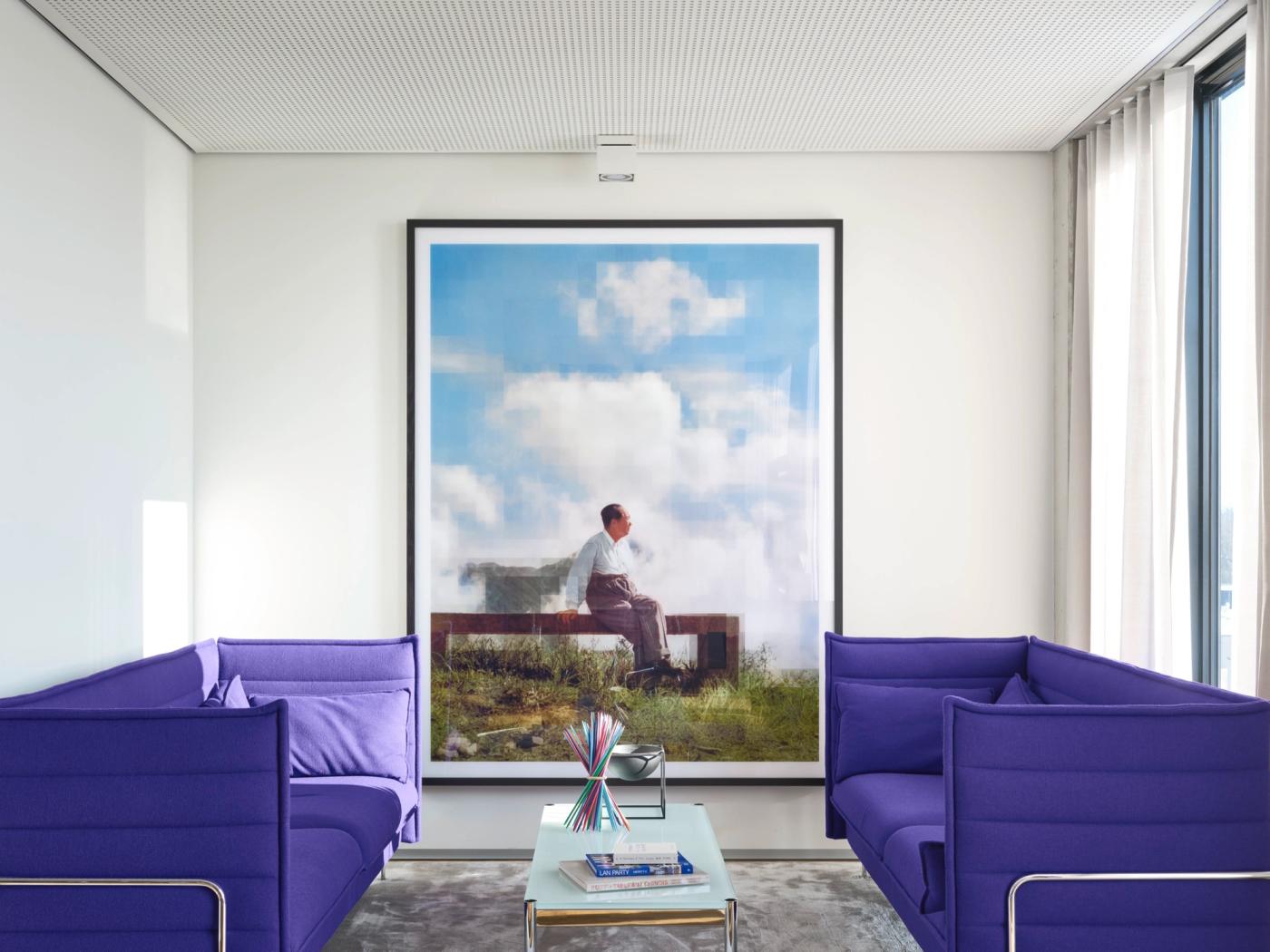
I’m torn between Thomas Ruff and the small sculpture by Nicole Wermers. With Ruff, you first see an idyll: mountains, nature, a view into the distance. The origin, however, is Chinese propaganda photography, which Ruff reworked digitally. This relaxed scene collides with something enormously explosive. The work hangs quite casually in an office, looking out onto the greenery. Even when things feel comfortable, in business there is always a layer that is not immediately visible.
Finally: what three tips would you give young collectors who are just starting out?
First: trust your own eye. You shouldn’t let yourself be guided too strongly by the opinions raining down on you. What matters is what gives you energy and what you want to live with – not the fact that someone recommended it.
Second: ask a lot of questions before you buy. Talk to many galleries, ask for prices, look at what an artist has done so far and where they currently stand. That’s how you learn to make sense of prices.
Third: don’t bet on returns. Financial motivation shouldn’t be the driving force – anyone who wants to make money is better off in the stock market. What matters is that you’re comfortable with the price and don’t burn through too much.
Experience the collection
Sammlung HertzLoan enquiries and visits: Greta Merz, info@sammlung-hertz.desammlung-hertz.de ↗
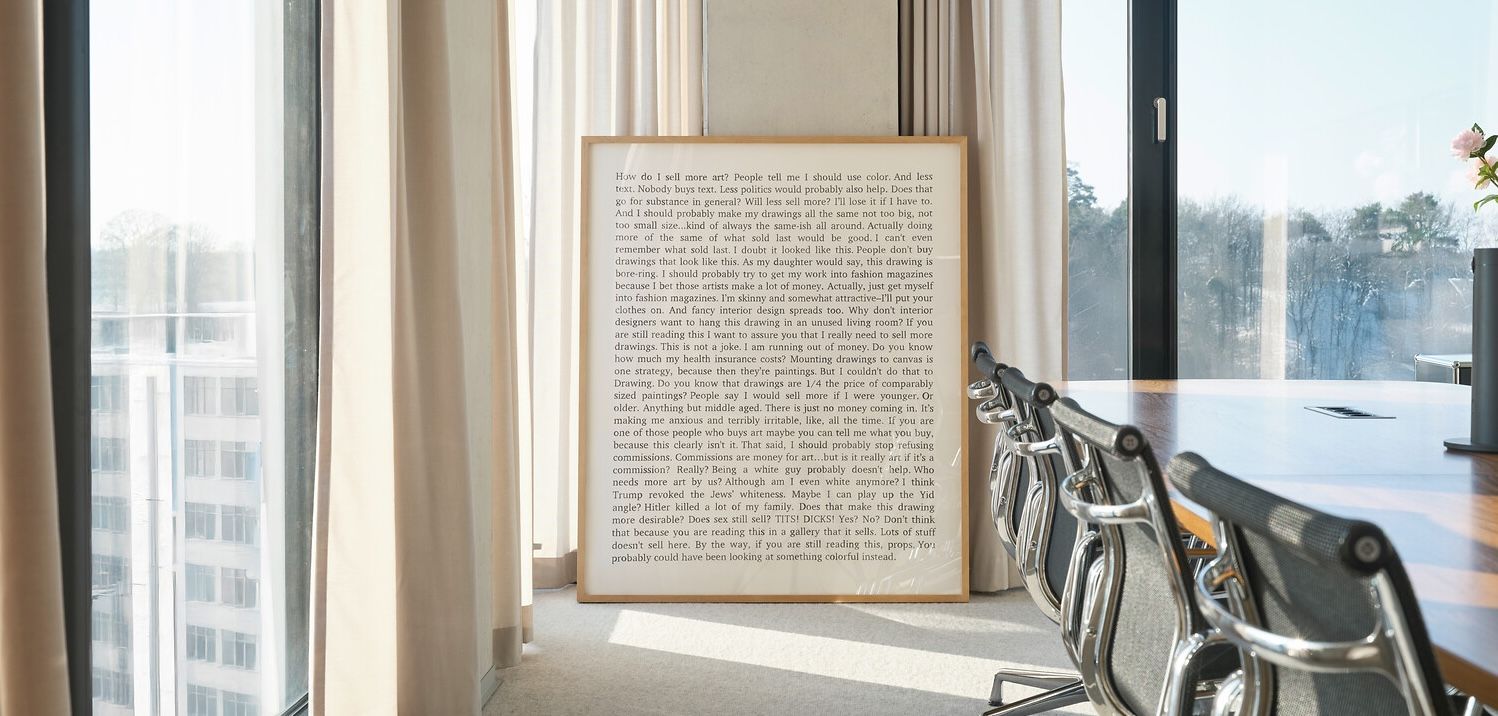
Cover image: Karl Haendel, “How Do I Sell More Art”, 2018, pencil on paper © Sammlung Hertz, photo: Jan Wesselmann
Portrait of Christoph Hertz (teaser image, alongside a work by Conny Maier, “Zorn 14 oder ein Feuer auswerfen”, 2025): photo by Paul Popanda